traditional catalogs
A list of services.
- Static inventories
- Manual ownership
- Limited operational awareness
- Disconnected tooling
- Periodic spreadsheet refreshes
platform · atlas
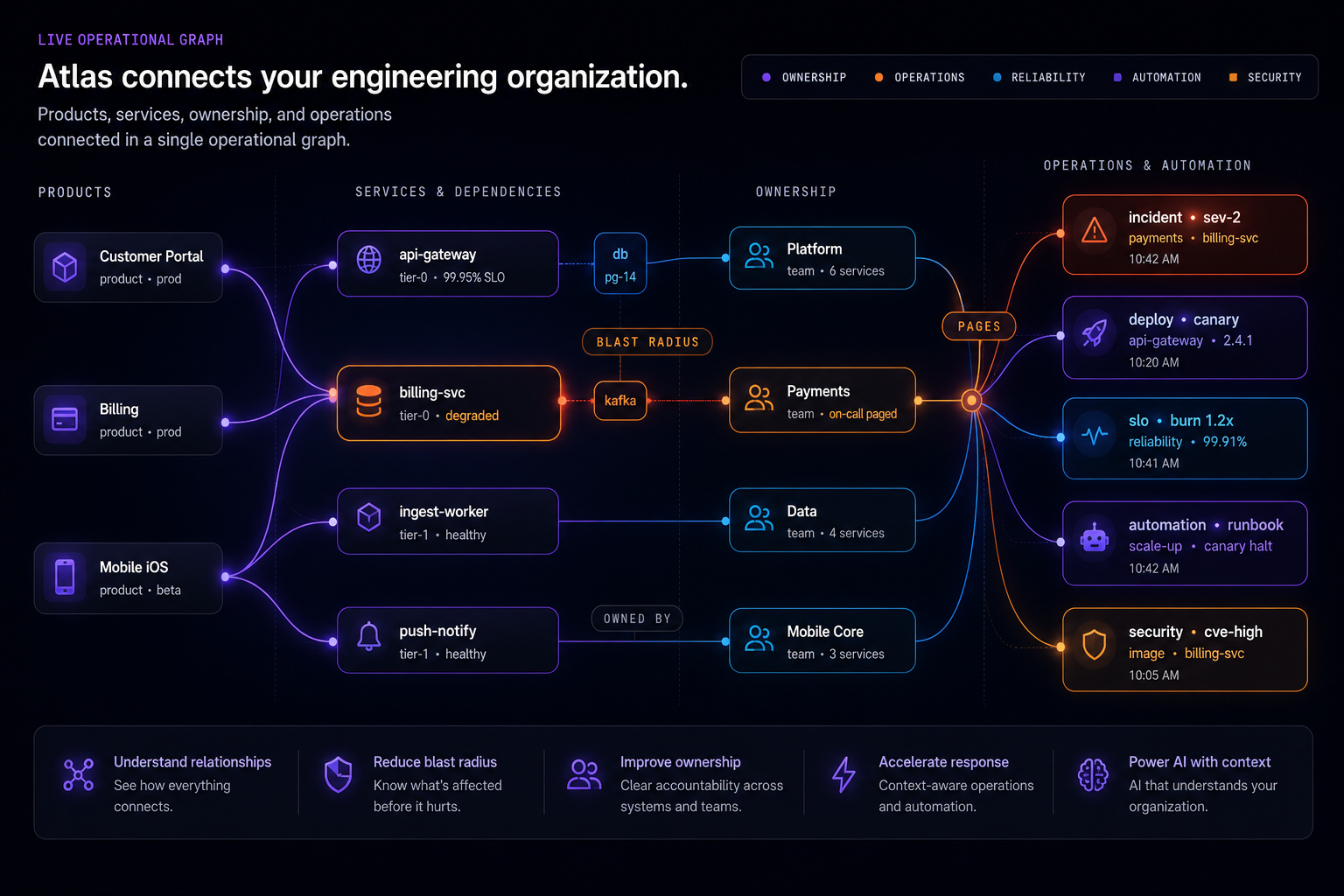
Atlas connects products, services, teams, ownership, dependencies, environments, and operations into a living operational graph.
Understand how systems, teams, and operational context connect across your organization.
operational graph · illustrative
the problem
Ownership becomes fragmented. Dependencies become invisible. Teams rely on tribal knowledge to understand operational impact. Critical context gets buried across disconnected systems.
Atlas creates a shared operational model for the entire engineering organization.
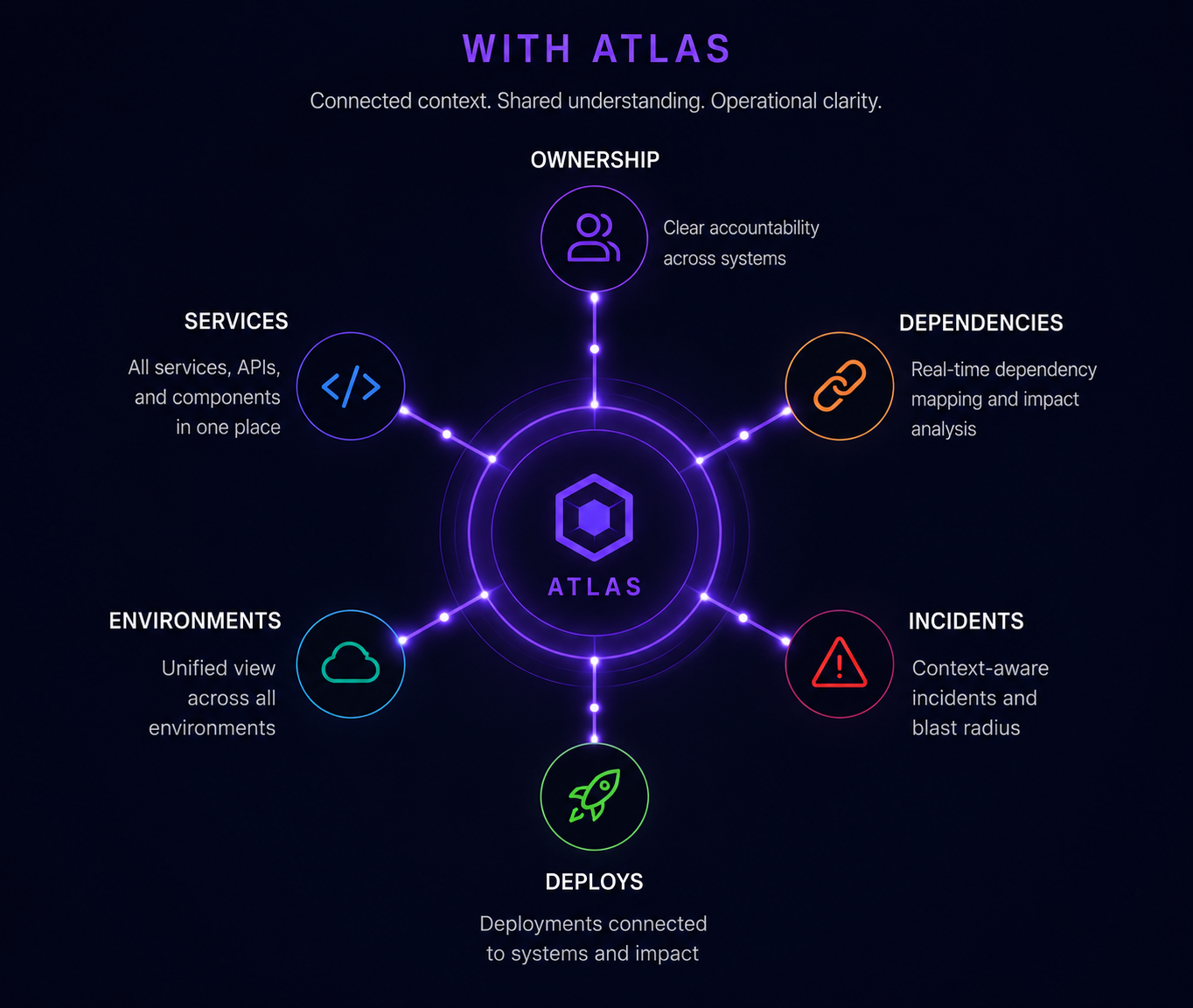
without atlas
Ownership, signals, and context are disconnected.
Ownership
Tribal knowledge and unclear accountability across systems.
Services
Scattered across teams, repos, and spreadsheets.
Dependencies
Invisible coupling and unknown change risk.
Environments
Split across regions, accounts, and tools.
Incidents
Context lost, hand-offs slow, blast radius unknown.
Deploys
Disconnected from systems, ownership, and impact.
what atlas models
Atlas doesn't stop at a service catalog. It connects the seven dimensions of an engineering organization into a single operational model — relationships first, inventories second.
Understand the systems your organization delivers — anchored in the customer-facing surfaces and outcomes you ship.
Map runtime systems, APIs, infrastructure, and operational boundaries — the things that actually run in production.
Connect organizational ownership and accountability so every part of the graph knows who is responsible.
Track responsibility across systems, environments, incidents, and operations — first-class records, not tribal knowledge.
Visualize upstream and downstream operational relationships — the runtime, data, and operational graph other tools assume but never store.
Model deployment environments, regions, and infrastructure boundaries so context follows where systems actually run.
Connect incidents, deployments, reliability, and automation back to the operational context they happened in.
These dimensions are connected — every node references the others, so context follows relationships, not silos.
how atlas powers the platform
Atlas gives Omnix the operational context needed to understand what exists, who owns it, how systems relate to each other, what is impacted, and what action should happen next.
Engineering insights become contextual instead of isolated — every signal lands on a node Atlas already knows about.
answers What's happening and what matters?
Incident coordination becomes ownership-aware and dependency-aware — response runs on the same graph as the systems being protected.
answers What needs response, and who owns it?
AI agents and workflows act with organizational understanding — execution carries the operational context that humans already have.
answers What can act?
ai · context
Most engineering AI systems operate on isolated signals. Atlas gives Omnix AI the context needed to reason across products, services, ownership, dependencies, reliability, operations, and automation.
reasoning trace · illustrative
outcomes
Every product, service, and environment knows the team accountable for it.
Coordination starts with the right people, runbooks, and impact already attached.
Changes and incidents land against the upstream and downstream graph that surrounds them.
Services without owners, environments without context, and orphaned dependencies surface automatically.
Teams share one operational model — instead of stitching together ten dashboards.
Reliability, security, FinOps, and delivery sit on the same graph as the systems they describe.
SLOs, error budgets, and burn rates sit next to the products and customers that depend on them.
Workflows and agents act with the same operational understanding humans use.
differentiation
Service catalogs answer "what exists." Atlas answers "what exists, who owns it, what it depends on, what's happening to it, and what should happen next."
traditional catalogs
atlas
Atlas is the operational topology layer. Everything else in Omnix runs on it.
early access
Atlas is in active development. Book a 30-minute walkthrough — we'll share the roadmap and find out what your operational graph should look like.