traditional tooling
A wall of disconnected tools.
- Isolated systems
- Fragmented signals
- Siloed ownership
- Manual correlation
- Context loss between tools
platform · integrations
Omnix connects delivery systems, infrastructure, observability, security, operations, and workflows into one operational intelligence platform.
Keep your tools. Connect the context.
the problem
Code lives in GitHub. Incidents live in PagerDuty. Metrics live in observability platforms. Deployments live in CI/CD pipelines. Security findings live in scanners. Ownership lives in tribal knowledge.
Omnix connects these signals into a unified operational graph, so every layer of the platform reasons over the same context.
without omnix
Six tools, six fragments, no through-line.
with omnix
One graph. The context already attached.
Cross-system correlation
Signals from every tool linked through one operational graph.
Live ownership
Service, owner, on-call, escalation. Never stale, never tribal.
Dependency awareness
Upstream and downstream relationships travel with every signal.
One operational record
Every action carries the context, the source, and the audit trail.
signal sources
Integrations are organised by operational domain, not as a flat marketplace. Each domain feeds a different shape of signal into the operational graph: delivery, infrastructure, observability, operations, security, communication, automation.
Code, work items, releases.
Where services run.
How services behave.
When something breaks.
Posture, vulnerabilities, access.
Where humans coordinate.
What runs without a human.
Names shown for context. Logos and full integration matrix available on request.
operational graph
Omnix connects signals across systems to understand relationships, ownership, dependencies, operational impact, and organisational context. Every signal lands in the operational graph the rest of the platform reasons over.
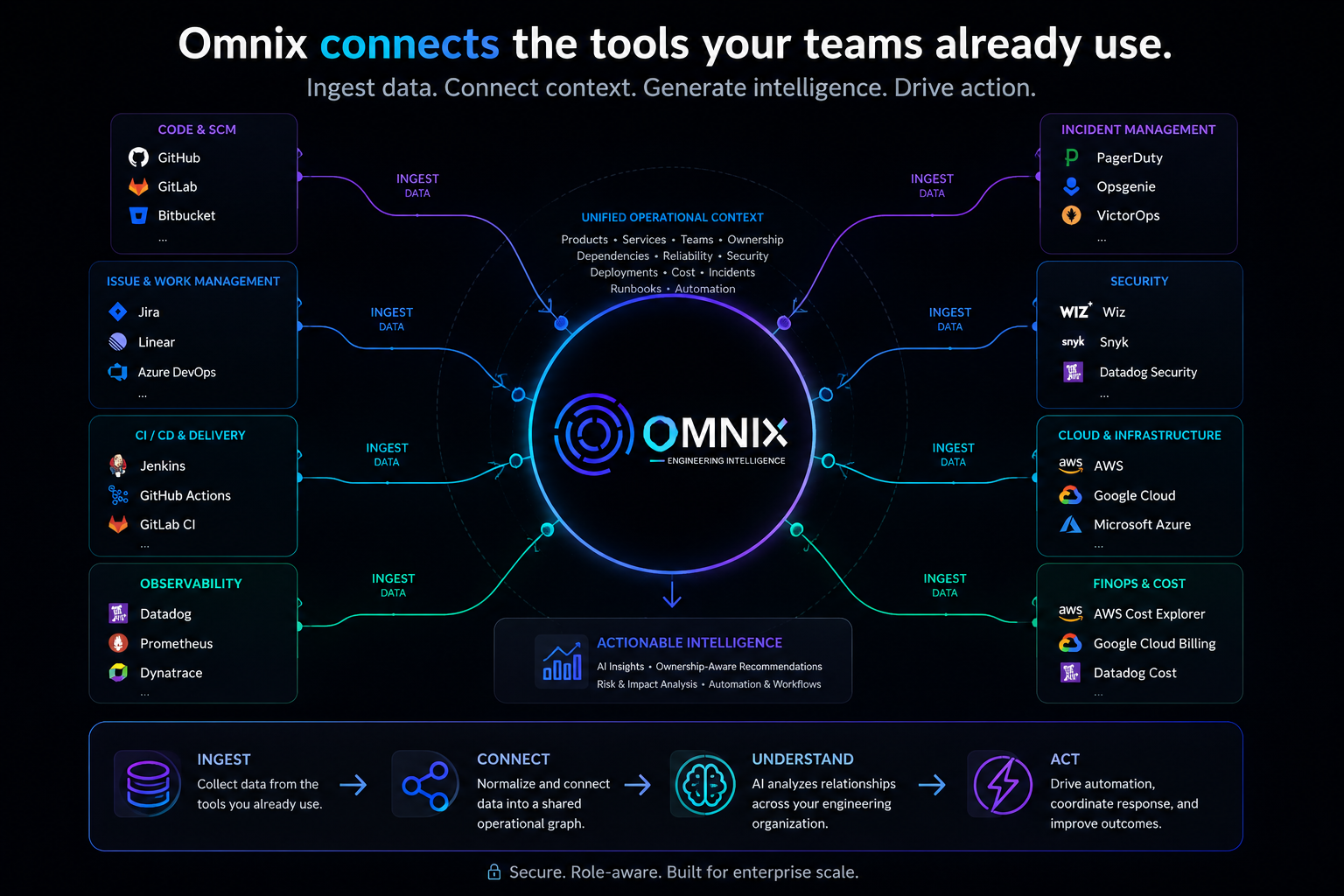
Every signal carries the context of the systems around it. A deploy knows the incident it caused. An alert knows the change that preceded it.
Upstream and downstream relationships travel with every signal, so impact and root cause surface together.
Service, owner, on-call rotation, approver, escalation path. Live, sourced, and attached automatically.
Workflows and Agent Teams run with full operational context, scope, and policy. No improvised state.
Atlas structures the graph. Intelligence reasons over it. Operations coordinates response. Automation executes action.
Integrations turn isolated signals into a connected operational nervous system. Atlas, Intelligence, Operations, and Automation all run on the graph integrations create.
real-time signal flow
Deployments, incidents, reliability signals, security findings, delivery events, infrastructure changes, and operational workflows continuously feed the Omnix operational graph. Context is always live.
GitHub commit
Repository, owner, file scope. Linked to the service it touches.
CI/CD deploy
Build, environment, change scope. Time-stamped against the running service.
Reliability regression
SLO burn, latency spike, error rate. Correlated with the deploy upstream.
Incident
SEV opened with blast radius, dependencies, recent change attached.
Ownership routing
Live rotation paged. Approvers, escalation path, comms channel ready.
Automation workflow
Remediation runs through Agent Teams or runbooks. Scope and policy enforced.
Resolution
Post-incident review starts with a complete operational timeline.
Continuous operational understanding. Every layer of the platform sees the same signals at the same time.
open platform
Omnix is designed to work across the engineering systems you already run, not to replace them. APIs, event streams, and webhooks are first-class so the operational graph can extend to internal tooling and custom systems.
Read and write the operational graph from your own services. Authenticated, scoped, audited.
Stream events from any system into the graph. Correlation happens server-side, not in your code.
Operational events fire workflows, runbooks, and Agent Teams with full operational context attached.
First-class extension points for the systems we don't ship out of the box. No vendor lock-in.
Bring internal services, home-grown dashboards, and bespoke pipelines into the operational graph.
Multiple environments, multiple regions, multiple business units. One operational model across them all.
ai powered by context
Omnix AI reasons across deployments, incidents, reliability, ownership, dependencies, cloud infrastructure, workflows, and operational relationships, because the platform understands how systems connect together.
Reasons across delivery, infrastructure, observability, security, and operations on one operational graph.
Understands upstream and downstream relationships before it speaks or acts.
Routes suggestions to the team accountable, with the context they need to decide.
Hands work to Agent Teams with scope, owner, approval path, and audit trail attached.
Reasons at the level of the organisation, not just a single service or single team.
AI is a property of the operational graph. It works because the integrations create the context to work with.
AI is valuable because the integrations create context. Without connected signals, AI is autocomplete. With them, AI reasons.
differentiation
Most engineering organisations run on dozens of operational tools. Each holds part of the picture; none holds the whole. Omnix integrates them so the picture becomes operational intelligence the entire org can act on.
traditional tooling
omnix integrations
Integrations
connect signals
Atlas
provides structure
Intelligence
provides understanding
Operations
coordinates response
Automation
executes action
Integrations are foundational. Without them, signals stay fragmented. With them, Omnix becomes the operational intelligence layer of the engineering organisation.
see it in action
Book a 30-minute walkthrough. We'll talk through which systems to connect first, the order they feed the graph, and what your operational intelligence looks like once they are linked.