solution · ai operations
AI operations with operational context.
Reduce coordination overhead, accelerate operational workflows, and scale engineering execution with context-aware AI systems.
AI becomes operationally useful when it understands systems, ownership, dependencies, and organisational context.
- CTO
- VP Engineering
- Platform leadership
- Operations leadership
- SRE leadership
- Engineering managers
02 · the coordination tax
Engineering operations become harder to coordinate at scale.
As engineering organisations grow, operational coordination fragments across systems, teams, incidents, workflows, deployments, ownership, and tooling. Nobody owns the full picture, so everybody pays a small tax to assemble it.
Teams spend increasing time coordinating work, switching context, routing information, prioritising response, and managing operational complexity. The coordination overhead grows faster than the organisation does, and operational throughput quietly erodes.
-
Coordination overhead
Engineering operations spread across systems, teams, tooling, and timezones. The work to keep it coordinated grows faster than the engineering org itself.
-
Cognitive load
Teams hold ownership, dependencies, deployment state, and operational risk in their heads. The picture is fragile, expensive to maintain, and hard to share.
-
Fragmented workflows
Tickets, runbooks, dashboards, chat threads, and approval queues live in parallel surfaces. Operational work stitches them together by hand, every time.
-
Operational fatigue
Context switching, manual routing, and prioritisation churn quietly compound. Operational throughput erodes long before anyone calls it a scaling problem.
03 · ai operations
AI that understands engineering operations.
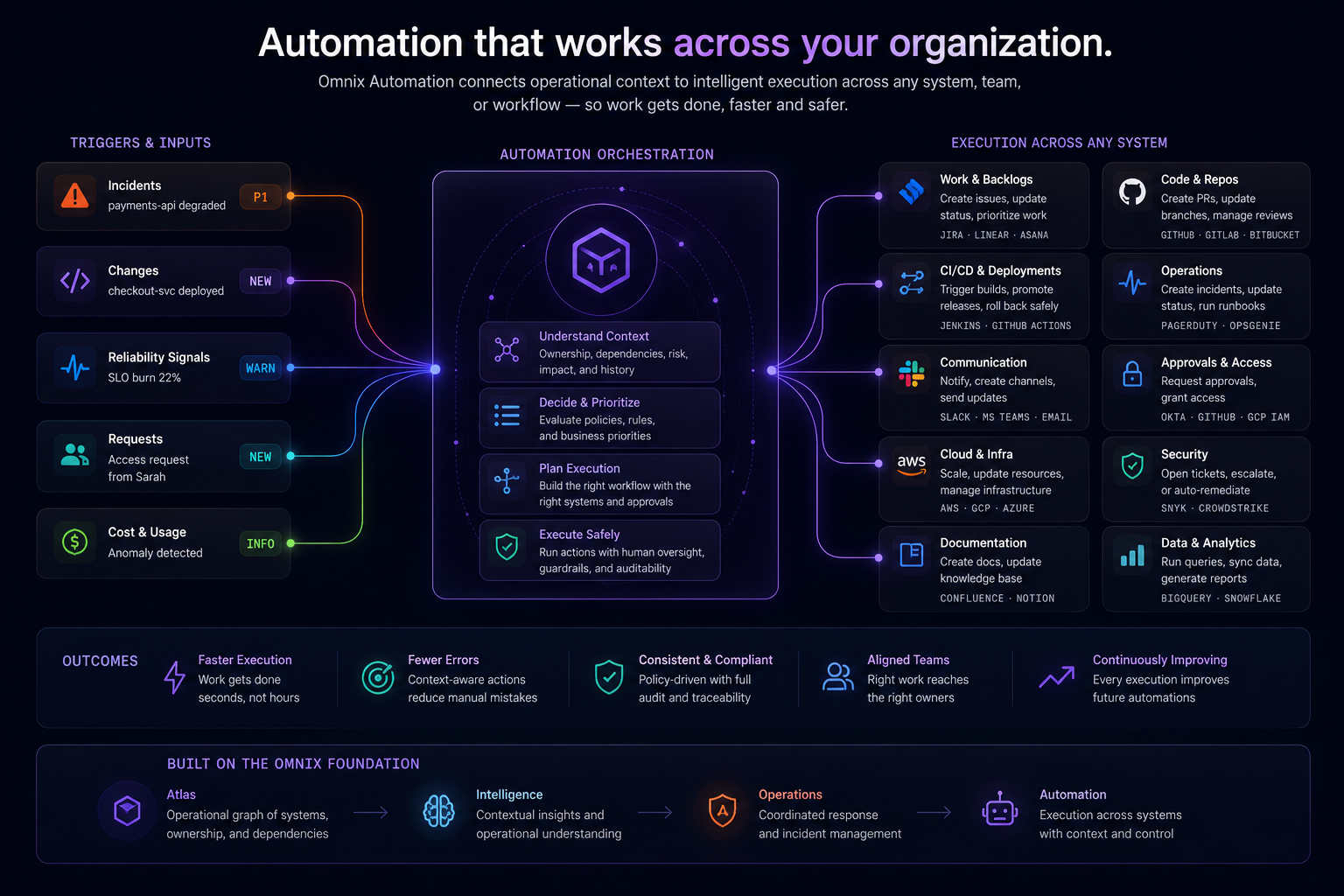
Operational AI is only useful when it understands the work it is operating on. Omnix AI Operations turns operational context into organisational outcomes, not isolated assistance: less coordination overhead, faster execution, better prioritisation, and operational leverage that scales with the organisation.
-
Reduce operational coordination burden
Routing, hand-offs, and follow-ups stop being manual operational work. Coordination becomes assisted, so engineering attention moves to the work that actually requires judgement.
-
Accelerate execution workflows
Operational workflows move faster because the context they need (ownership, dependencies, change history, risk) is already attached, not chased down per task.
-
Improve prioritisation
Operational priority follows organisational impact, not the loudest channel. AI assists leaders and teams in deciding what matters now, with shared context.
-
Reduce context switching
Engineers spend less time reconstructing what changed, who owns it, and what depends on it. Operational understanding becomes ambient instead of expensive.
-
Assist operational response
Incidents, escalations, and time-sensitive work get help with routing, scoping, and context, so response time is not bottlenecked on locating the right humans.
-
Scale engineering operations
Operational throughput stops scaling linearly with headcount. Coordination, prioritisation, and execution gain organisational leverage, not just team-level effort.
04 · contextual support
Operational context changes everything.
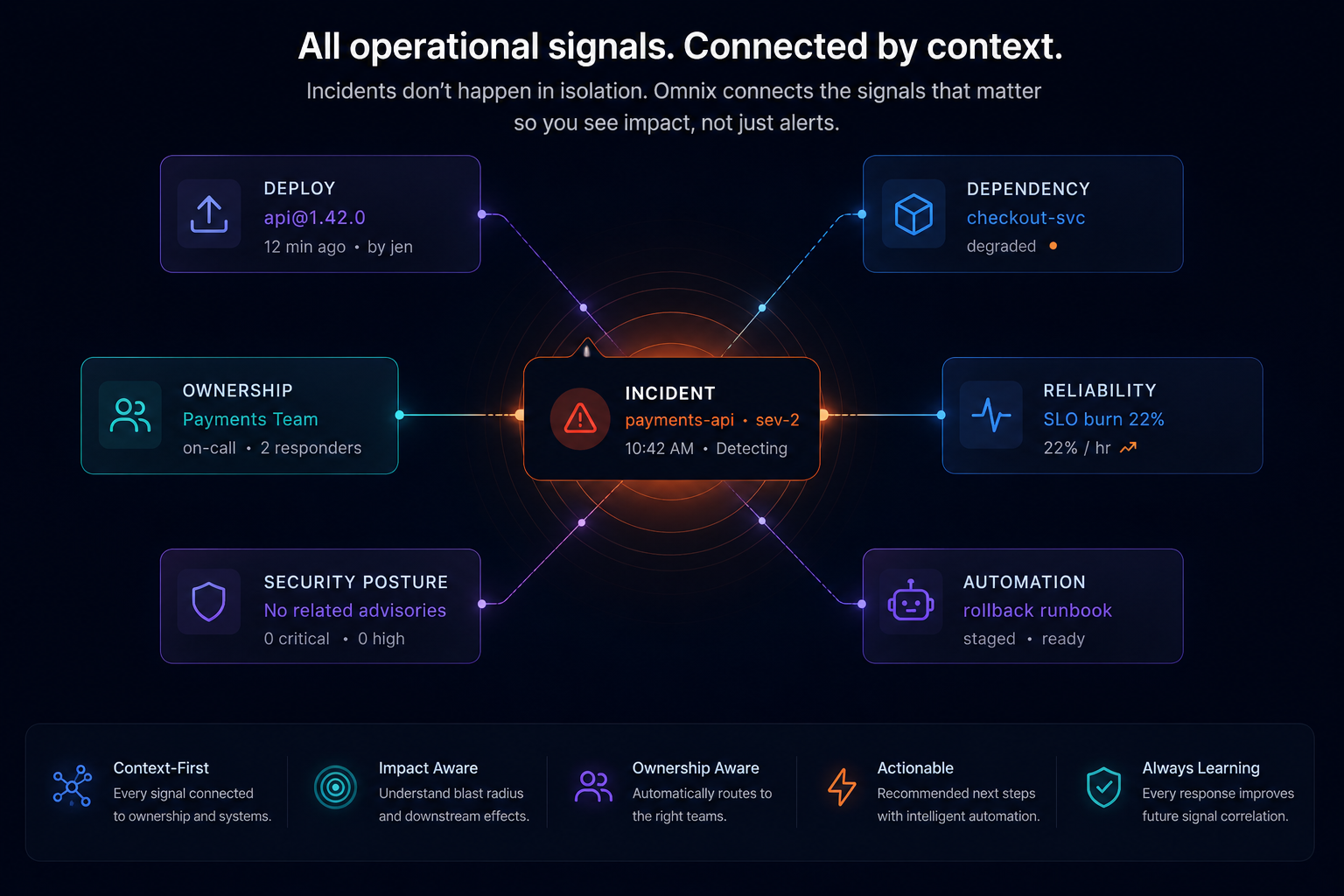
AI systems become significantly more useful when they understand systems, ownership, dependencies, operational risk, reliability, deployments, and organisational relationships. Without that context, assistance is generic. With it, assistance is operational.
Omnix AI reads from the same operational picture humans do. Suggestions, routing, and drafts arrive grounded in the systems they touch and the teams accountable for them, so the answer is operationally legible, not generically confident.
-
Operational understanding
AI reasons across services, products, and teams as one connected operational picture, not isolated tickets. Suggestions are grounded in how the organisation actually runs.
-
Ownership awareness
Every action references real owners and accountable teams, so coordination flows to the right humans automatically and stops bouncing between groups.
-
Dependency reasoning
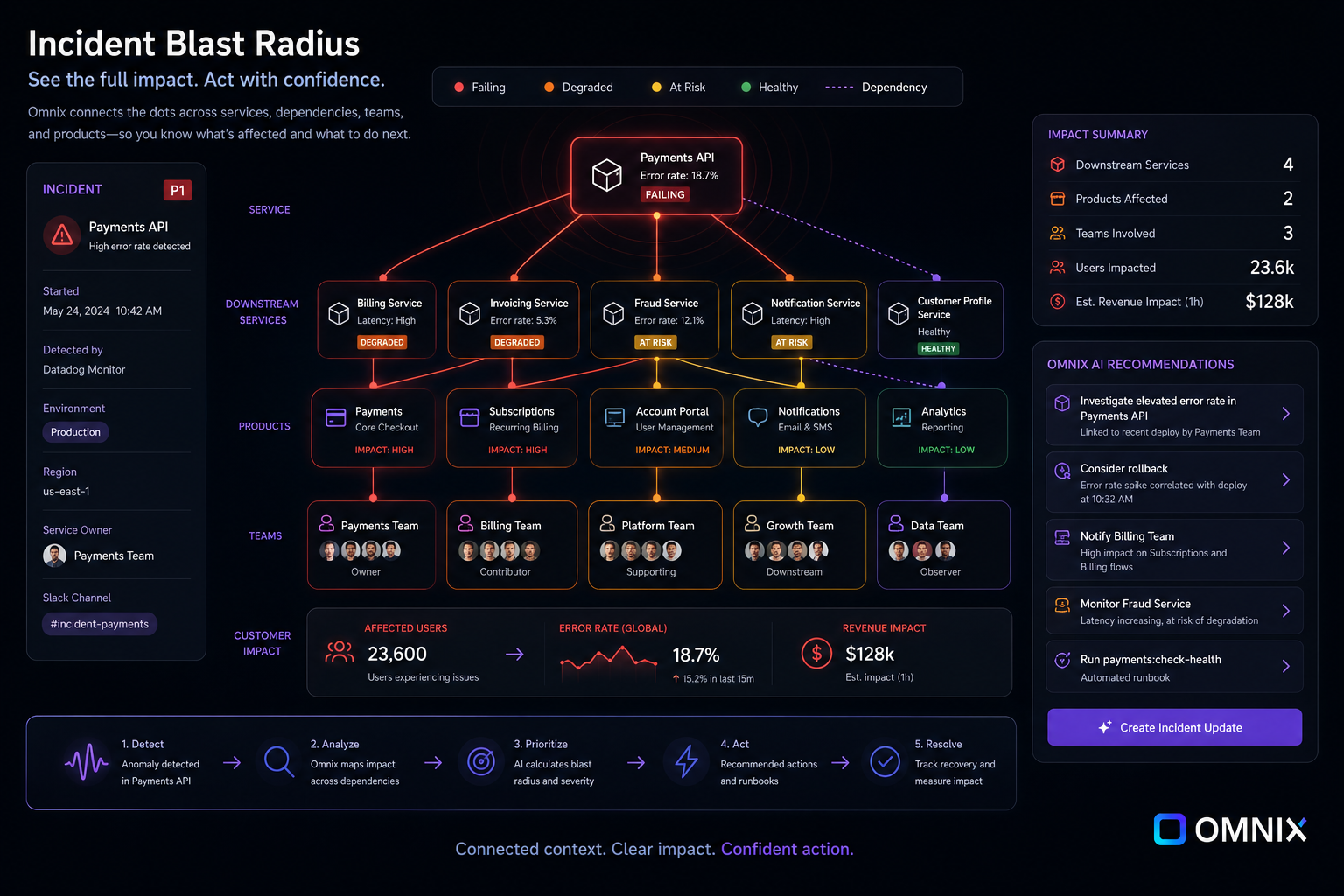
Upstream and downstream relationships are part of the operational context, so AI assistance considers blast radius, risk, and adjacent teams, not just the immediate surface.
-
Operational prioritisation
Severity, business impact, and reliability posture are weighed together, so AI helps leaders prioritise from organisational state instead of the most recent notification.
05 · operational productivity
Reduce operational overhead across engineering teams.
Engineering teams spend significant time coordinating operational work manually across systems, workflows, communications, incidents, and organisational boundaries. That work is real, costly, and largely invisible to leadership until throughput starts to slip.
Omnix AI Operations helps reduce coordination friction and accelerate operational execution. Routine assembly work becomes assisted, so engineering attention moves to the parts of the work that actually require judgement.
-
Workflow acceleration
Routine operational work runs faster because context, ownership, and routing are pre-attached. Engineers move to the decision step without the assembly step.
-
Reduced manual coordination
Pings, status pulls, and hand-off threads become rarer. Coordination overhead falls because the operational picture is already shared by default.
-
Reduced cognitive overhead
Engineers stop carrying the operational graph in their heads. Context lives where the work lives, and AI surfaces it on demand instead of by memory.
-
Organisational efficiency
The same operational throughput costs less attention. Leadership inherits operational leverage, not new tooling to maintain alongside the rest.
06 · response & execution
Coordinate operational response faster.
AI-assisted operational workflows help organisations prioritise incidents, route ownership, coordinate response, surface impact, and accelerate remediation. The minutes engineering used to spend assembling context become minutes spent resolving the actual issue.
The point is not more incident tooling. The point is that response coordination stops being a manual operational task and becomes something the organisation does with leverage, the same way it ships software.
- · Faster prioritisation
- · Ownership-aware routing
- · Cross-team coordination
- · Escalation support
- · Impact awareness
- · Response acceleration
07 · human + ai
Humans and AI coordinating together.
Omnix AI Operations is designed to assist engineering organisations, not replace them. Operational authority stays with the humans accountable for the systems. AI handles the assembly, routing, and context retrieval that has no business consuming engineering attention.
Humans and AI operate inside the same operational picture, so trust comes from shared context, not opaque automation. Decisions arrive informed instead of improvised, and the people accountable still hold the authority they should.
-
Human-in-the-loop operations
AI assists, drafts, and routes. Humans decide. Operational authority stays with the people accountable for the systems, not with an autonomous agent.
-
Assisted coordination
Coordination work gets help, not replacement. AI handles the assembly, routing, and context retrieval that has no business consuming engineering attention.
-
Decision augmentation
Engineering and leadership decisions arrive with context attached: ownership, dependencies, history, and risk, surfaced together so judgement is informed, not improvised.
-
Organisational collaboration
Humans and AI coordinate inside the same operational picture. Trust comes from shared context, not from opaque automation acting in the background.
08 · operational scaling
Scale engineering operations without scaling coordination overhead.
Operational complexity grows faster than engineering organisations can manually coordinate. Headcount cannot keep pace with coordination cost, and bolting on more tooling does not change the underlying shape of the problem.
Context-aware AI changes the slope. Coordination, prioritisation, and execution gain organisational leverage instead of more team-level effort, and operational maturity becomes something leadership can actually invest in.
- · Faster execution
- · Reduced coordination friction
- · Improved operational responsiveness
- · Better organisational alignment
- · Operational leverage at scale
- · Resilient engineering operations
09 · ai & context
AI is only useful when it understands operational context.
Omnix AI reasons across systems, ownership, dependencies, deployments, reliability, workflows, and operational relationships to provide meaningful operational assistance. Generic AI gives you confident answers. Contextual AI gives you operationally correct ones.
-
Contextual reasoning
Reasons across systems, ownership, dependencies, deployments, reliability, and operational state together, so assistance is operationally meaningful, not generically helpful.
-
Organisational awareness
Understands how teams, products, and services relate, so coordination flows the way the organisation actually does, not the way a generic assistant would guess.
-
Execution intelligence
Connects operational context to the action, so suggestions, drafts, and routing are grounded in the systems they touch and the humans accountable for them.
10 · outcomes
Operational leverage at organisational scale.
What changes when coordination, prioritisation, and execution share a single operational context instead of fragmenting across systems and teams.
-
Reduced operational coordination overhead
-
Faster execution workflows
-
Improved operational responsiveness
-
Reduced context switching
-
Better operational prioritisation
-
Improved engineering productivity
-
Stronger operational coordination
-
Scalable engineering operations
11 · beyond ai assistants & automation tools
Beyond AI assistants and automation tools.
Generic AI tooling
- · Isolated AI assistants
- · Limited operational context
- · Workflow silos
- · Generic automation
- · Reactive interactions
- · Per-tool intelligence
Omnix AI Operations
- → Operational understanding
- → Context-aware coordination
- → Organisational reasoning
- → Operational prioritisation
- → Cross-system awareness
- → Engineering execution support
Most tools give engineering organisations an AI assistant.
Omnix gives engineering organisations an operational coordination layer.
see it in action
See AI-assisted operational coordination across your engineering organisation.
Book a 30-minute walkthrough. We'll show you what AI operations look like when systems, ownership, dependencies, and operational context share one connected picture, framed for the way CTOs, VP Engineering, and platform leadership actually run engineering at scale.
- Read-only access. We never push, comment, or merge.
- SOC 2 Type II in progress. Audit period H2 2026.
- Code stays in your VCS. We read metadata, not your repo contents.