traditional ops tools
An alert stream.
- Alert streams
- Isolated incidents
- Manual coordination
- Limited operational context
- Tool fragmentation
platform · operations
Coordinate incidents, runbooks, escalations, and remediation workflows with ownership-aware operational intelligence.
Understand impact, coordinate response, and take action across connected systems.
incident coordination · illustrative
the problem
Alerts fire everywhere. Ownership is unclear. Dependencies are invisible. Teams lose time understanding blast radius, operational impact, and coordination paths during incidents.
Operations connects incidents, systems, ownership, deployments, reliability, and automation into one coordinated operational response layer.
without operations
Six signals, six tools, no coordination.
with operations
One incident, with all of the context already attached.
Owner
Payments. On-call paged from the live rotation.
Blast radius
checkout-svc · customer-portal degraded.
Likely cause
Correlates with payments-api@1.42.0 deploy.
Suggested action
Roll back deploy · open mitigation runbook.
incident coordination
Understand operational impact instantly through ownership, dependencies, deployments, reliability signals, and connected systems. All on one view.
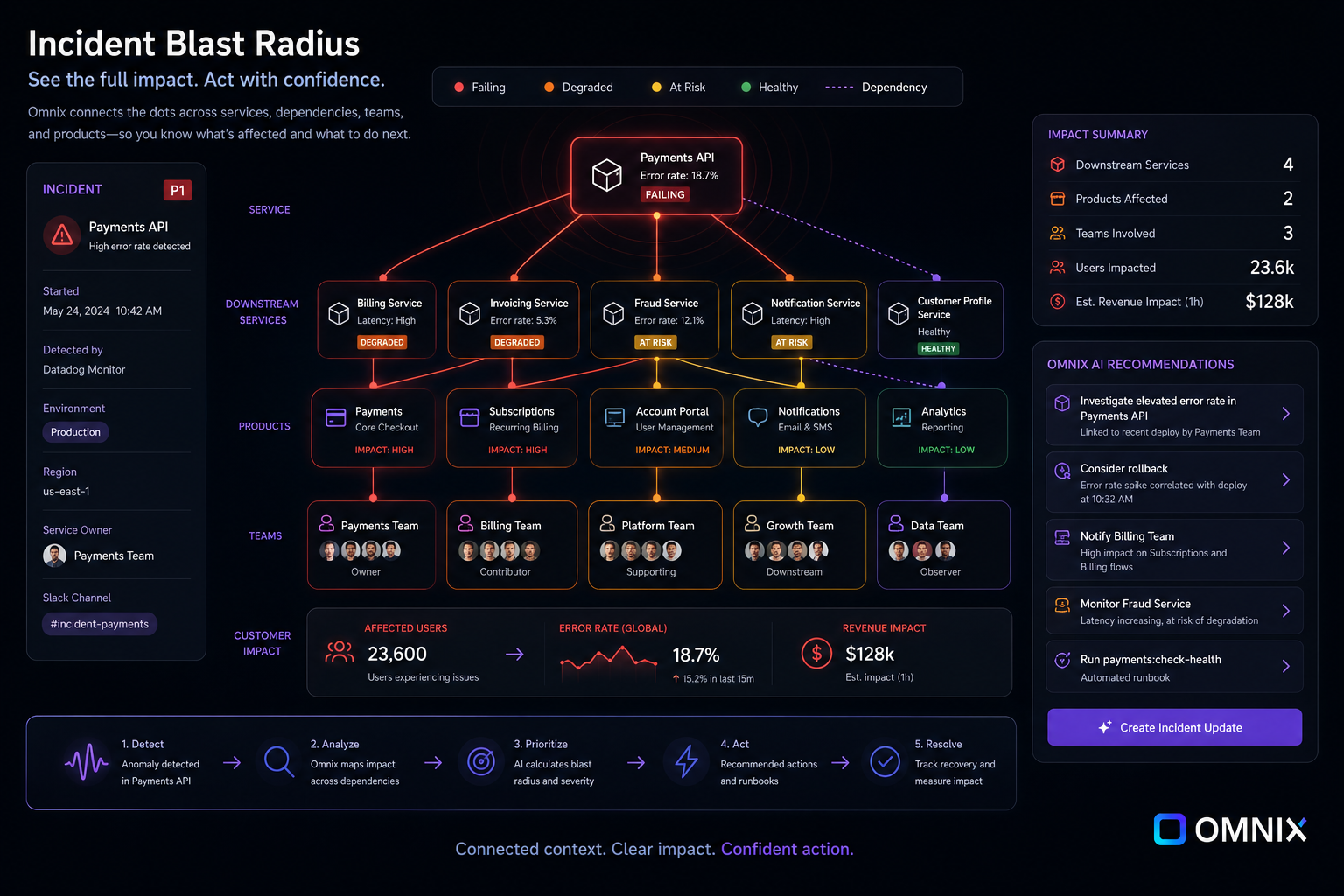
Every failing service maps to the products, customers, and teams it affects.
Page the right team the first time. Escalation follows real ownership, not stale rotations.
Upstream and downstream relationships travel with every incident, automatically.
Severity reflects what's actually impacted: services, customers, SLOs. Not alert volume.
Hand-offs preserve full state: timeline, comms, runbook progress, related deploys.
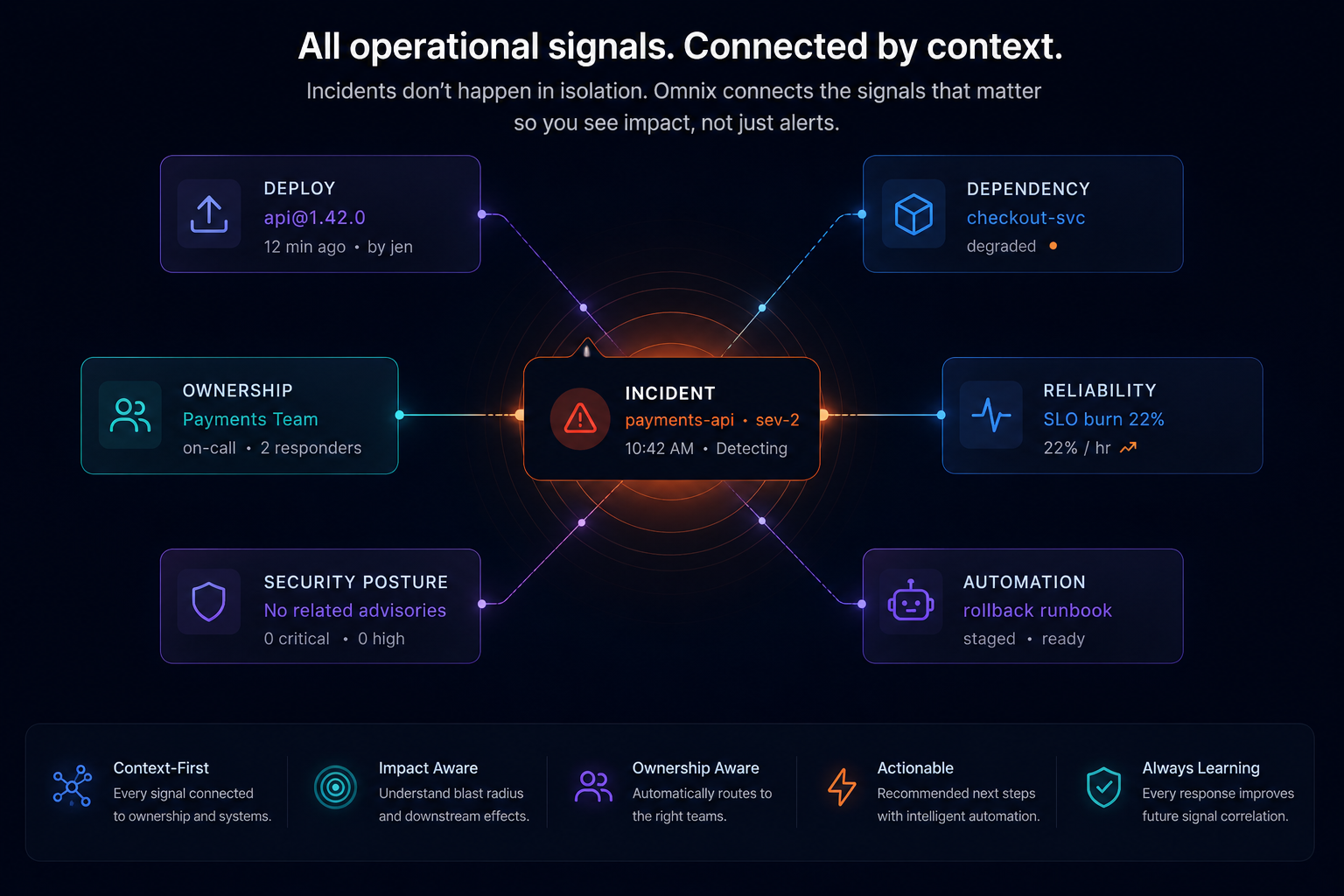
Recent deploys, related incidents, and reliability posture surface alongside the alert.
Incidents propagate through operational relationships. Operations coordinates response across them.
operational context
Operations connects incidents to deployments, ownership, dependencies, reliability, security posture, and automation, through the same operational graph Atlas keeps current.
runbooks & response
Connect runbooks, remediation workflows, approvals, escalations, and automation to operational context, so response is execution, not improvisation.
Incident
Severity, timeline, and impact already attached the moment the alert lands.
Ownership
On-call paged from the live rotation. Approvers, escalation paths, and comms routes ready.
Response steps
Runbook selected by service + symptom. Each step shows context and current state.
Automation
Routine steps execute through Agent Teams; humans approve the high-stakes ones.
Recovery
Post-incident review starts with a complete record: timeline, decisions, owners.
deployments & change impact
Connect deployments, configuration changes, and operational events to incidents, reliability, and downstream systems, so the question "what changed?" is answered before it's even asked.
T-0
Deploy
payments-api@1.42.0 shipped to prod-eu
T+04m
Latency spike
p95 +280% on /charge endpoint
T+06m
Incident
SEV-2 opened · checkout-svc degraded
T+08m
Rollback
1.42.0 reverted · approved by Payments
T+12m
Recovery
p95 normalised · SLO burn paused
operational intelligence
Most AI operations tools summarise alerts. Omnix Operations reasons across systems, ownership, dependencies, deployments, reliability, and organisational context.
Reasons across the live operational graph: what's affected, who depends on it, who owns it.
Understands upstream and downstream relationships before it speaks.
Routes suggestions to the team accountable, with the context they need to act.
Suggests next moves grounded in runbooks, recent incidents, and current posture.
Severity reflects real impact: services, customers, SLO burn. Not alert volume.
Hands work off to Agent Teams with full operational context: owner, scope, approval path.
Embedded, not bolted on. Calm under pressure.
automation handoff
Operations connects incidents and operational workflows directly into Automation and Agent Teams, so escalation, remediation, approvals, and orchestration share one operational model.
Incident
Severity, ownership, blast radius attached.
Operational understanding
Cause, dependencies, recent changes connected.
Agent Teams
Specialist agents read the operational graph and propose work.
Automation workflows
Routine remediation steps execute with full context.
Human approval
High-stakes moves stay with the team accountable for them.
Recovery
Post-incident review starts with a complete timeline.
Atlas
provides structure
Intelligence
provides understanding
Operations
coordinates response
Automation
executes action
differentiation
Traditional operations tools surface incidents. Omnix Operations understands what changed, what's impacted, who owns it, what depends on it, and what action should happen next.
traditional ops tools
omnix operations
Atlas provides the operational graph. Operations coordinates response across it.
see it in action
Book a 30-minute walkthrough. We'll show you what incident response looks like when blast radius, ownership, deployments, and recommended action share one operational view, and how coordination connects directly into Agent Teams.