solution · service ownership
Operational ownership without tribal knowledge.
Understand who owns what, how systems connect, and who needs to act when operational issues happen.
Create accountability, visibility, and coordination across engineering systems and teams.
- CTO
- VP Engineering
- Platform leadership
- SRE leadership
- Engineering Operations
02 · the ownership gap
Ownership breaks down as organisations scale.
Teams change. Systems evolve. Dependencies grow. Critical operational knowledge becomes fragmented across spreadsheets, wikis, chat threads, and tribal knowledge.
When incidents happen, organisations lose time figuring out who owns what, what systems are impacted, and who needs to respond.
-
Tribal knowledge
Ownership lives in the heads of long-tenured engineers, in private chat threads, and in spreadsheets nobody updates after a reorg.
-
Unclear accountability
When something fails, the first ten minutes are spent figuring out which team owns it. Responsibility is assumed, not recorded.
-
Hidden dependencies
Cross-team dependencies stay invisible until they break. Teams ship into systems they don't realise other teams rely on.
-
Escalation friction
Routing the right people to the right problem takes pages, threads, and guesswork instead of one shared operational picture.
03 · operational ownership
Operational ownership across systems and teams.
Replace folklore with a continuous operational view of accountability. Ownership stops being something the long-tenured engineers carry, and becomes something the organisation actually shares.
-
Clear accountability
Every product, service, and operational surface has a recorded, current owner. Responsibility stops drifting between teams as the org changes shape.
-
Service ownership across teams
Ownership is connected to the systems engineers actually run. Teams, on-call rotations, and code stewards line up with the work, not last quarter's org chart.
-
Operational responsibility
Move beyond 'who wrote it' toward 'who runs it'. Operational ownership covers reliability, on-call, and day-two responsibility, not just authorship.
-
Escalation visibility
Escalation paths are operational, not folkloric. When something needs to move up, the next person in the chain is already known.
-
Reduced tribal knowledge
New engineers, new managers, and new leaders inherit operational understanding instead of reconstructing it through Slack archaeology.
-
Cross-team coordination
Ownership becomes the connective tissue between teams. Coordination starts from a shared operational view, not parallel investigations.
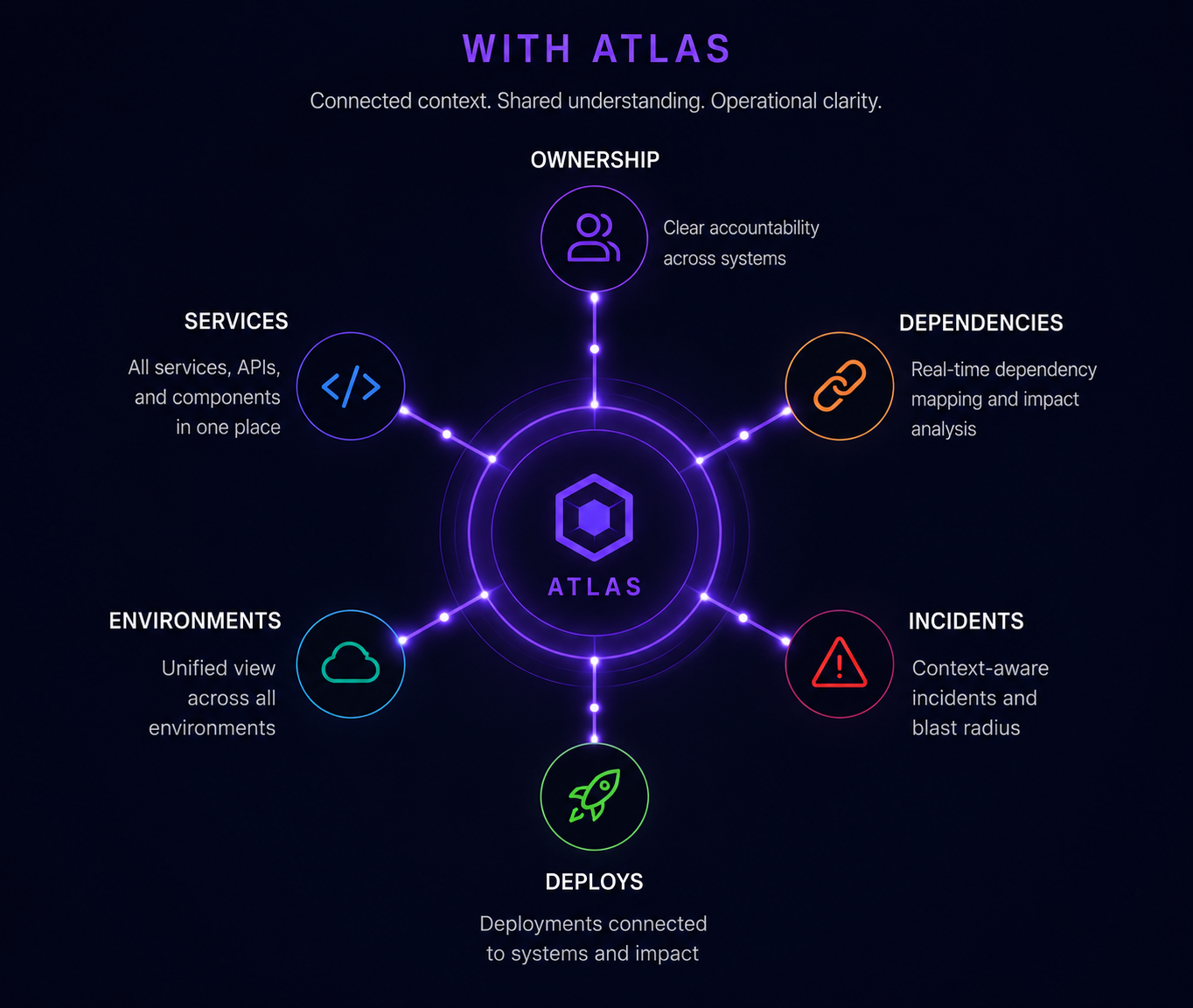
04 · dependency visibility
Understand how systems connect.
Operational ownership only works when dependencies are visible. Omnix surfaces the upstream, downstream, and cross-team relationships that decide whether a change is routine or organisationally significant.
Teams stop shipping into systems they did not realise other teams depended on, and leadership stops being surprised by blast radius after the fact.
-
Upstream and downstream visibility
See which systems sit above and below every service, and which teams stand behind them. Dependency questions take seconds, not stand-ups.
-
Blast radius awareness
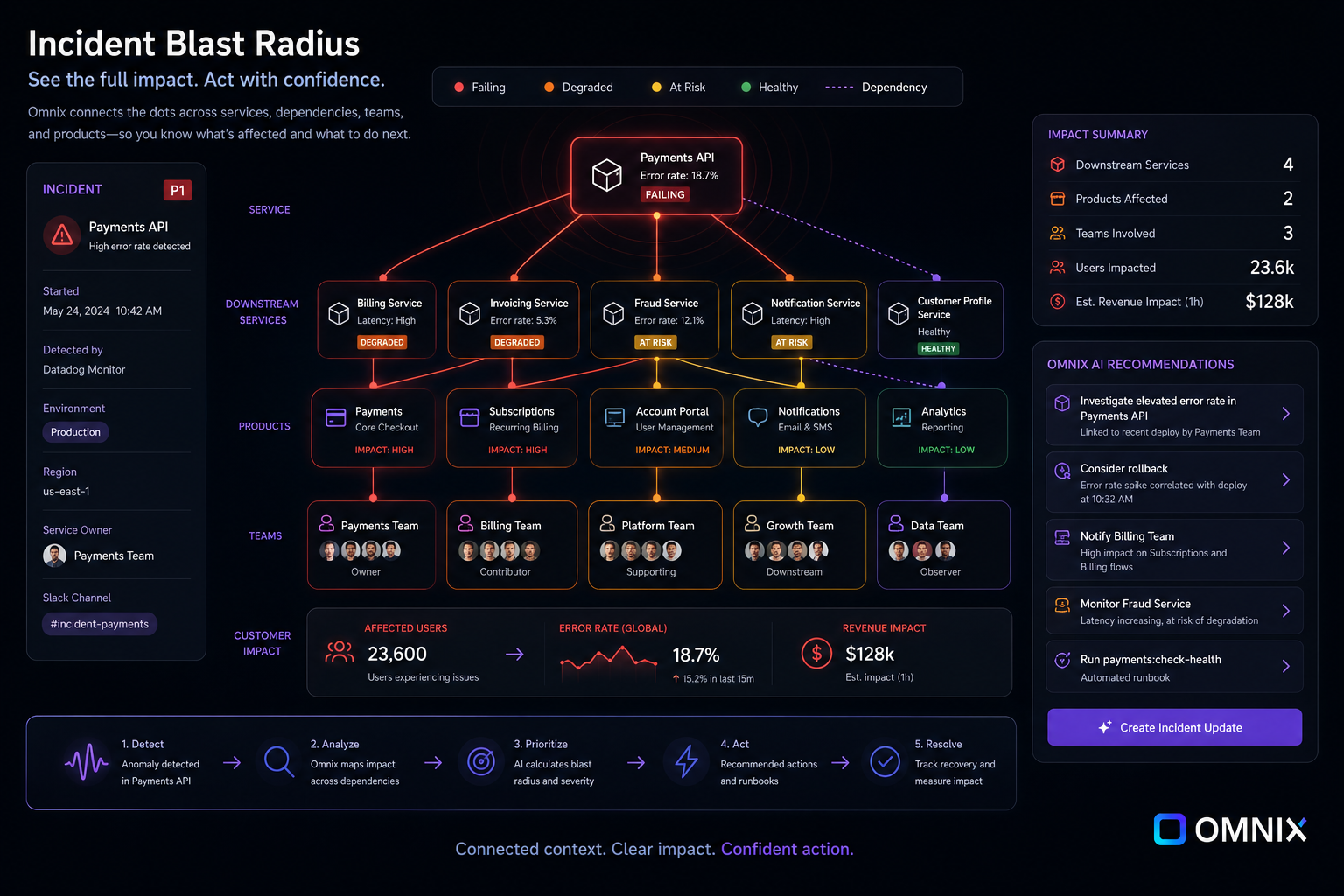
Understand what a failing component actually affects: downstream services, products, customers, and the teams whose day just changed.
-
Operational impact understanding
Move from 'this service is down' to 'this is what is impacted, who owns it, and who needs to coordinate'. Impact becomes operational, not abstract.
-
Coordinated change
Changes in shared systems become legible to every team that depends on them, before they ship, not after the post-mortem.
05 · incident & escalation
Know who needs to respond.
When operational issues happen, Omnix helps the organisation quickly understand affected systems, responsible teams, escalation paths, and operational impact without paging across half the org.
The first ten minutes of an incident stop being a search for ownership and start being a coordinated response.
-
Right team, first time
Routing follows current ownership. Pages reach the team that actually runs the failing component, not the team it used to belong to.
-
Faster coordination
Responders share one operational picture: affected systems, owners, escalation paths, and operational impact, surfaced together.
-
Escalation clarity
When a problem needs to move up, the path is already known. No '/who-owns' threads at 2am.
-
Reduced response delays
The minutes lost to figuring out who responds become minutes spent actually responding.
06 · organisational coordination
Coordinate across the engineering organisation.
Ownership is more than metadata. It is how engineering organisations coordinate delivery, operations, reliability, security, and response.
When teams share an operational view of ownership and dependency, coordination stops being a meeting and starts being the default.
-
Organisational visibility
See how teams, services, products, and operational responsibilities connect across the engineering organisation, not team by team.
-
Cross-team understanding
Teams stop guessing what other teams own and start coordinating from the same operational view.
-
Engineering alignment
Delivery, reliability, security, and operations work from one shared map of ownership and dependency, not five.
-
Accountability at scale
Accountability stays clear as the organisation grows, splits, and reshapes. Ownership doesn't decay with every reorg.
07 · leadership visibility
Leadership visibility into operational accountability.
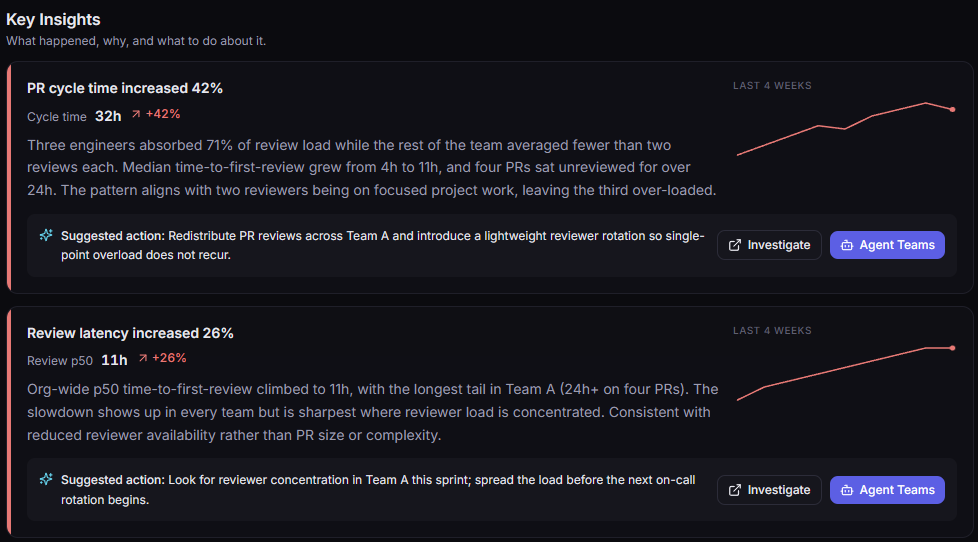
Engineering leaders gain confidence when ownership, dependencies, escalation paths, and operational responsibility are visible across the organisation, not buried inside individual teams.
Reorgs, on-call changes, and coverage gaps stop being discovered during incidents.
- · Clear accountability
- · Reduced operational ambiguity
- · Faster escalation
- · Improved coordination
- · Better organisational understanding
- · Stronger operational resilience
08 · operational AI
AI that understands ownership and operational context.
Omnix AI reasons across ownership, dependencies, operational relationships, and organisational context to surface actionable operational understanding.
-
Ownership-aware reasoning
Treats teams, on-call rotations, and operational responsibility as first-class context for every operational question.
-
Dependency-aware understanding
Reasons across upstream, downstream, and shared systems together, not service by service.
-
Organisationally aware
Knows which teams, products, and escalation paths are connected to a given operational situation, and routes attention accordingly.
09 · outcomes
Operational accountability at organisational scale.
What changes when ownership, dependencies, and escalation are shared operational understanding instead of tribal knowledge.
-
Reduced tribal knowledge
-
Faster incident coordination
-
Clear escalation ownership
-
Improved dependency visibility
-
Better operational alignment
-
Stronger organisational coordination
-
Reduced operational ambiguity
-
Confident leadership oversight
10 · beyond service catalogs
Beyond service catalogs.
Traditional catalog
- · Static ownership metadata
- · Limited operational context
- · Manual updates
- · Weak dependency visibility
- · Minimal coordination across teams
- · Catalog as documentation
Omnix Service Ownership
- → Operational ownership
- → Connected service relationships
- → Dependency awareness
- → Escalation visibility
- → Cross-team coordination
- → Context-aware operational understanding
Most tools give engineering organisations a catalog.
Omnix gives engineering organisations operational accountability.
see it in action
See operational ownership across your engineering organisation.
Book a 30-minute walkthrough. We'll show you what ownership, dependencies, and escalation look like when they share one operational view, framed for the way engineering leadership and operations actually coordinate.
- Read-only access. We never push, comment, or merge.
- SOC 2 Type II in progress. Audit period H2 2026.
- Code stays in your VCS. We read metadata, not your repo contents.